A single supplier for materials, machines and consumables
A dental laboratory rarely buys one thing at a time, and the XANGTECH range is organised around that reality. Zirconia blocks, lithium disilicate and PMMA discs cover the restoration itself, while milling machines, sintering furnaces and scanners cover the digital chain that shapes and finishes it. Milling burs, glaze paste and grinding stones sit alongside as the small items a bench reaches for every day, so an order can cover a whole workflow rather than a single shelf.
The company describes itself as a one-stop dental laboratory supplier. Materials come first because every case starts with a blank, equipment follows because every blank needs shaping and firing, and tools close the loop because every finished piece needs adjustment and polish. A buyer can therefore start from a case type, work outward to the material and the machine it needs, and check the consumables before sending an inquiry.
Why zirconia blocks anchor the whole range
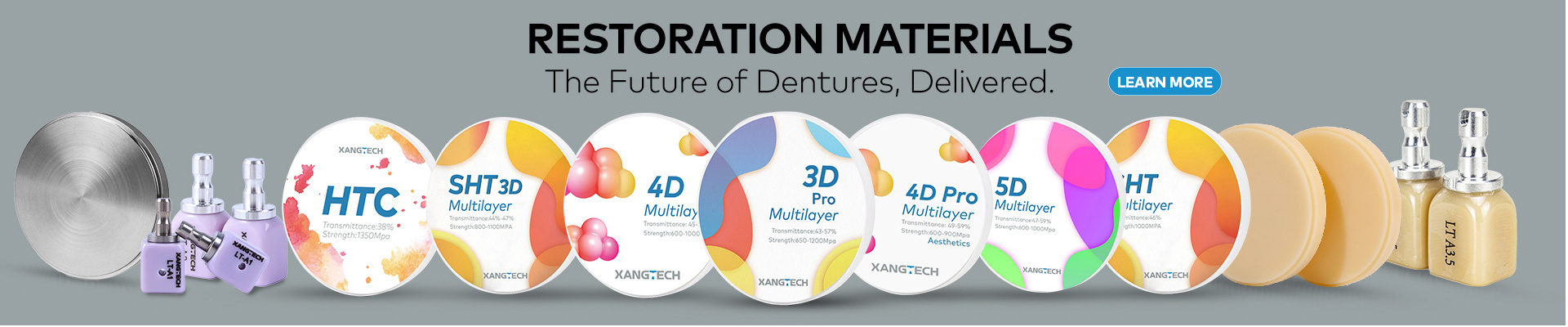
Zirconia blocks are the most visible part of the range, and for good reason: a single disc family feeds crowns, bridges and implant-supported work across the laboratory. The white, pre-shaded and multilayer families each answer a different shade problem, so a laboratory can match a blank to the case in front of it instead of staining every unit from a single shade. Multilayer discs, including the 4D Pro and 3D Pro lines, add a shade gradient inside the blank itself, which shortens the finishing step for anterior work.
The zirconia pages on this site keep that distinction in view. Category pages explain the three families side by side, product pages describe named lines in plain language, and selection guides compare them without promising laboratory results. Where a number would matter, such as a strength or translucency figure, ask for the figure in an inquiry.
Digital equipment that follows the material
A blank becomes a restoration only through milling, sintering and scanning, and the equipment pages mirror that sequence. The XT-60 dry and wet milling machine handles zirconia, PMMA, PEEK, titanium block and glass ceramic, the RX-8H covers metal milling, and the 12S fast sintering furnace and PF1200D porcelain furnace cover the firing steps that follow. The XT-OS05 intraoral scanner sits at the front of the chain, capturing the case before any cutting begins.
Presenting equipment beside materials matters because the two choices interact. A laboratory choosing a multilayer disc wants to know which milling machine in the same range handles it, and a laboratory buying a furnace wants to know which blanks it will fire. This site therefore links each equipment page back to the materials it works with, and each material page forward to the machines that shape it, without claiming that any combination has been tested together.
Consumables the bench actually uses
Milling burs, glaze paste and grinding stones rarely headline a catalogue, yet a laboratory without them stops work. The burs range covers zirconia, ceramic glass, PMMA and metal, with names that match third-party systems such as VHF and Cerec only as compatibility references in the source listings. Glaze paste and grinding stones appear as category names in the source catalogue, and this site keeps them at that level rather than inventing named products for them.
Treating consumables honestly protects both sides of an inquiry. A buyer who sees a bur listed by the material it mills can ask whether it fits a particular holder, and a buyer who sees glaze paste listed as a category can ask which shades are actually stocked. The inquiry pages on this site are built for exactly those questions, with space to name the material, the machine and the consumable in a single message.
How to read the evidence on this site
Every product name on this site comes from a source listing, and every figure that does appear is quoted from one named product page. The XT-60 page is the only page that carries a specification table, because it is the only named product whose source page published one in full. Other product pages use descriptive language only, and where a specification would normally appear, the page asks the reader to confirm it in an inquiry instead of filling the gap with an estimate.
Certificates are available upon request, and the certificate names that appear in the company profile are named here with that profile as the source. Ask for the certificate number, issuing body, scope and validity period for the exact product in an inquiry. A buyer who needs a document for a particular market can ask for it by name in an inquiry.
Starting an inquiry from any page
Each page ends with the same practical step: send an inquiry naming the product, the quantity range and the questions that matter for that case. The inquiry form asks for a name and an email address so a reply can reach the sender, and the message field is open, because dental orders vary too much for a fixed checklist. A buyer can paste a case description, a shade requirement or a machine compatibility question into that field without fitting it into preset boxes.
Before payment, please confirm the payment method, the minimum order quantity, the lead time and the shipping method for the specific items in the inquiry. Those four confirmations appear on the inquiry pages as buyer instructions, not as company promises, because the applicable terms depend on the items, the quantities and the destination. A short inquiry that names those four points will get a faster and more precise answer than a long one that leaves them out.
('The range in one view: blanks, machines, finishing', ['A laboratory that has never ordered from this range can use the home page as a map: blanks on the materials pages, machines on the equipment pages, and finishing items on the tools pages, with guides between them for every choice that needs explaining. The map matters because a dental order is rarely a single item, and a buyer who can see the whole range at once will write a better inquiry than one who discovers each item separately. The navigation at the top of every page follows the same map, so the route from a blank to its furnace never requires a search.', 'That map also shows where the evidence is strongest and where it stops. The XT-60 milling machine page carries a published specification table, the zirconia and furnace pages describe their products in plain language without tables, and the certificate and order pages say plainly that documents and terms are confirmed in an inquiry rather than promised on a public page. A buyer who reads the map with those distinctions in mind will ask questions that the company can actually answer, instead of questions that assume evidence the site never claimed.'])
('For a laboratory buying its first XANGTECH item', ['A laboratory new to this range should start small: one disc family, one bur set, or one machine inquiry, and test the reply quality, the delivery and the product before committing further. The inquiry form supports that approach, because it asks only for a name, an email address and an open message, and a message that says it is a test order will be treated as one, with advice on the item choice that will make the test most informative. That first test is worth more than any catalogue claim, because it measures the supplier rather than the brochure.', 'The test should also cover the chain, not just the item: a blank tested without its milling and sintering combination leaves the most important questions unanswered, while a blank tested with its machine and furnace answers them together. A laboratory that tests a multilayer disc, for example, should note the nesting software, the milling machine and the furnace in the same inquiry, so the test result reflects the real workflow rather than an isolated disc. The guides on this site are written to help plan exactly that kind of test.'])
('For a distributor carrying the range', ['A distributor reading this home page is looking at a different question from a laboratory: not which item suits one case, but which range suits several laboratories at once, and on what terms. The materials, equipment and consumables sides of the range together let a distributor assemble a catalogue for its own customers, from blanks to burs, and the inquiry form can carry that range question in one message, with quantities per item and markets named. A distributor inquiry should say that it is a distributor inquiry, because the quotation that follows will differ from a laboratory quotation.', 'Distributors should also note the evidence restraint that runs through this site, because it affects what a distributor can promise its own customers. That restraint protects the distributor as much as the company, because a promise repeated downstream is harder to correct than one made once.'])
('What to do next on this site', ['The next step depends on the reader: a laboratory with a case in mind should go to the material family that fits it, read the guide for that family, and then send an inquiry naming the product, the size, the shade approach and the quantity range. A laboratory equipping a bench should go to the equipment index, work through scanning, milling, firing and extraction in order, and then send a combined inquiry for the whole setup. A reader who only wants background should go to the guides, which explain every major choice without requiring any form at all.', 'Whichever route a reader takes, the inquiry form waits at the end of it, linked from the navigation, the footer and the closing band on every page, so the moment browsing turns into a question never requires hunting for an address. The form asks only for a name, an email address and the message, and a message that names the product, the quantity and the four confirmations will get a quotation that can be acted on. That is the whole journey this site is built for, from a first look at a disc to a confirmed order.'])
('A note on how this site handles evidence', ['Every claim on this site traces to a source listing or a determination, and the pages say so wherever a claim could be doubted. The founding year appears only as a MIC profile statement, the export reach appears only as a company self-description, and the certificate names appear only at name level, because those are the forms in which the evidence actually arrived. ', ' A specification table appears for the XT-60. Ask for the firing curve for your blank and furnace combination in an inquiry. A site that filled those gaps with estimates would look more complete while actually being less trustworthy, and a buyer who relied on an estimated figure could order the wrong item. The inquiry form exists precisely for the figures this site declines to guess.'])