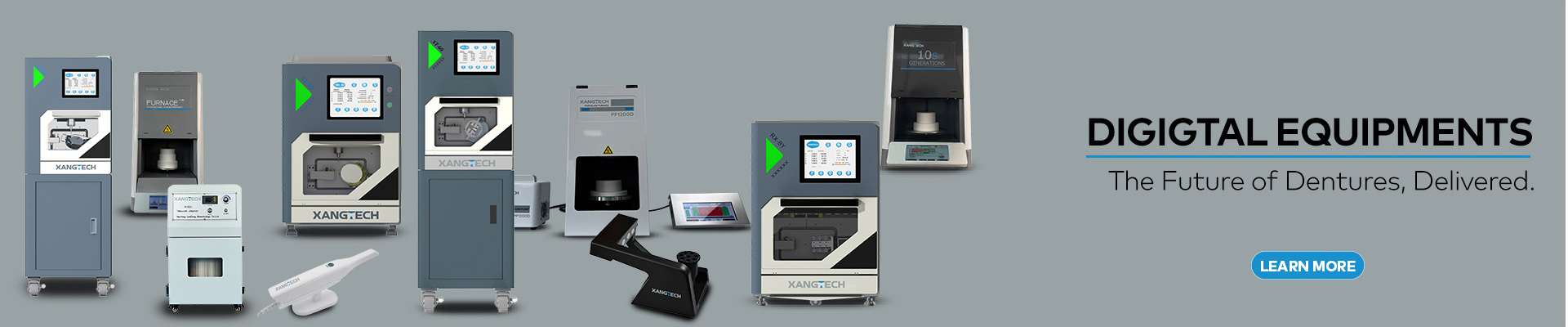
What the XT-60 is
The XANGTECH XT-60 Dry and Wet Milling Machine, also listed as a five-axis dental milling machine, covers both dry and wet milling in a single frame. That dual mode is its defining feature: a laboratory can mill zirconia and PMMA dry, and glass ceramic and metal wet, without changing machines between case types. The product page on the official website lists the machine under both the dry and wet description and the five-axis description, and this site keeps both descriptions together rather than splitting them into two products.
The XT-60 page is also the only page on this site that carries a specification table, and the reason is evidence, not preference. Its source page published a table in full, and this site reproduces it below in the source page's own terms, including its original spellings and unit writings. Other product pages use descriptive language only. Ask for a comparable table for the exact model in an inquiry.
The specification table, as published
The table below reproduces the XT-60 source page's specification list, checked item by item before publication on this site. Each row is a single claim from that page, and no row has been added, extended or generalised to the rest of the range. A buyer reading the table should treat it as a statement about this machine only, and should not read any row as a claim about the RX-8H, the furnaces or any other product on this site.
Two rows deserve a reader's attention in particular. The machinable materials row lists zirconia, PMMA, PEEK, titanium block, titanium column and glass ceramic, which is the widest material list of any machine page on this site, and the processing type row lists veneers, inlays, high-mounted inlays, full crowns and implant-supported restorations, which is the widest case list as well. Those two rows together explain why the XT-60 is presented as the general-purpose machine in the range, while the RX-8H is presented as the metal-focused machine.
Reading the table carefully
Some entries in the table use the source page's own spellings, including itinerary range for the axis travel entry and rmp for the spindle speed unit, and this site keeps those spellings rather than silently correcting them. A buyer who needs a clarified figure, such as the exact meaning of an axis range or a pressure rating, should ask about that row in an inquiry, quoting the row, so the company can confirm it against the machine's current documentation. Silent correction on a catalogue page would hide exactly the question a buyer most needs to ask.
The table also has limits that a careful reader should note. It does not give a throughput figure, a bur life figure or a comparison result against any other machine. A laboratory planning a purchase on throughput should describe its case volume in an inquiry and ask for the relevant figure, rather than estimating it from a table that was never designed to answer that question.
Materials the XT-60 machines
The machinable materials row is the most practical row in the table, because it decides whether a laboratory's case mix fits this machine at all. Zirconia and PMMA cover the bulk of crown and bridge work, PEEK and titanium block cover specialised cases, titanium column covers implant-related work, and glass ceramic covers the aesthetic end. A laboratory whose case mix sits inside that list can consider the XT-60 as its general machine, while a laboratory whose mix sits mostly outside it should look at the RX-8H or ask about a different machine.
The material list also connects the XT-60 page to the materials pages on this site. Each material family has its own category and guide pages, and a buyer can move from a material page to this machine page and check the combination directly. If a material a laboratory uses is not on the list, the inquiry form is the place to ask whether it can be milled on this machine, naming the material and the case type, rather than assuming that an unlisted material works.
Cases the XT-60 processes
The processing type row lists veneers, inlays, high-mounted inlays, full crowns and implant-supported restorations, which covers the main fixed prosthetic cases a laboratory handles. That list describes the machine's intended case range; individual cases vary in preparation, design and material. A laboratory with an unusual case should describe it in an inquiry and ask whether this machine's table covers it, rather than reading the row as a blanket approval.
The case list also explains the machine's place beside the furnaces and scanners on this site. A veneer or crown milled on the XT-60 still needs sintering or firing, and still needs scanning at the front of the chain, so the machine page links to the furnace and scanner pages as the next steps. A buyer equipping a laboratory should read those pages together, and confirm the whole chain in a single inquiry, rather than ordering the machine alone and discovering a missing link later.
How to order an XT-60
An order should name the machine as XT-60 Dry and Wet Milling Machine, describe the case mix and the materials to be milled, and note any existing equipment it must work beside, such as a scanner or a furnace already in the laboratory. Then confirm the minimum order quantity, lead time, shipping method and payment terms as buyer instructions, because those vary by order and destination and are not promised on this page. A machine order also benefits from naming the installation and training questions early, so the reply can address them alongside the quotation.
Because a milling machine is a larger purchase than a box of blanks, a buyer may want to discuss installation, training and after-sales support in the first inquiry rather than after delivery. The inquiry form has room for those questions, and naming them early lets the company answer them while the quotation is still open, when they can still affect the decision. The form asks only for a name, an email address and the message itself.
| Item | Specification as published on the source product page |
|---|---|
| Net size | 530*650*1550 |
| Net weight | 281kg |
| Itinerary Range | XYZ: 190/96/99mm; A: 360 degrees; B: +30 to -90 degrees |
| Power | 2.5kw |
| Repetitive Positioning Accuracy | ±0.03mm |
| Tool magazine | 21 |
| Processing Methods | Five Axis Wet and Dry Milling |
| Spindle speed | 0-60,000rmp |
| Rated working pressure | 6.0-7.5bar (anhydrous, oil-free) |
| Voltage | 220-230V |
| Machinable materials | Zirconia, PMMA, PEEK, Titanium Block, Titanium Column, Glass Ceramic |
| Processing type | Veneers, Inlays, High-mounted Inlays, Full Crowns, and Implant-supported Restorations |
| Machinable material thickness | 10-30mm |