Start from the case, not the catalogue
A zirconia choice that starts from a product name usually ends in a compromise, because the product was chosen before the case was understood. A choice that starts from the case, the tooth position, the shade system and the laboratory's staining routine, usually ends in a family that fits, because the family was chosen for the work it has to do. An anterior crown with a visible gradient points one way, a posterior bridge with a standard shade points another, and a case with an unusual shade points a third way entirely.
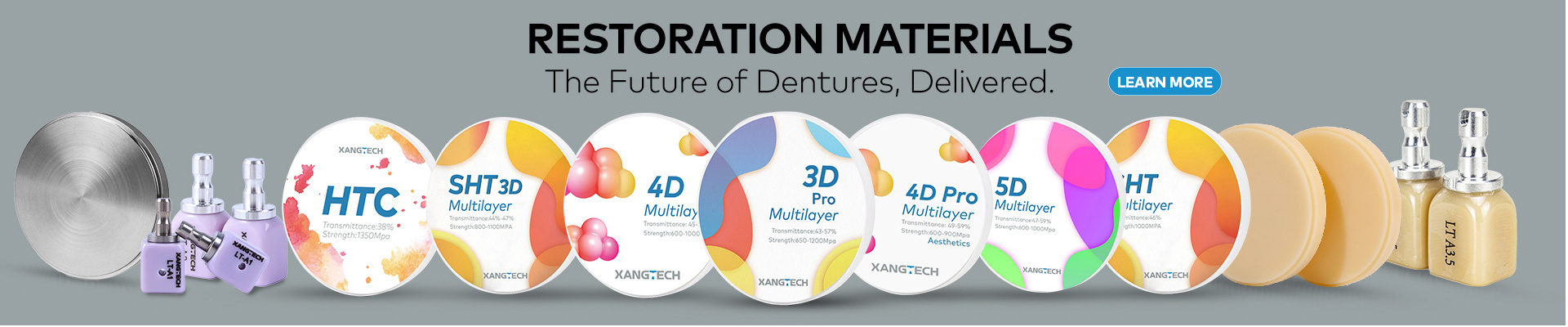
The three families on this site map onto those starting points in a simple way. White blanks suit a laboratory with a settled staining routine and a case that needs full shade control, pre-shaded blanks suit a laboratory working mostly in standard shades that wants to skip staining, and multilayer blanks suit a laboratory that wants a gradient already inside the disc. Those are directions, not prescriptions, and the rest of this guide develops each one with the caveats that belong to it.
White blanks: control at the cost of a step
White blanks give the technician the most shade control, because the stain is applied to the milled shape rather than chosen in advance. That control suits a case with an unusual shade, a case that must match a neighbouring tooth precisely, or a laboratory whose staining routine is already a strength. The cost is a step: staining takes time, skill and consistency, and a laboratory without a settled routine may find white blanks slower and less predictable than the other families.
White blanks also suit a laboratory that stocks few shades, because one white blank plus a staining set covers a wider shade range than a shelf of pre-shaded blanks. That stocking advantage matters for a small laboratory, where shelf space and inventory cost both count. A buyer considering white blanks should note the staining system in use, and confirm the white blank's disc size and availability in an inquiry, because those are the practical facts a catalogue category page cannot fix.
Pre-shaded blanks: speed for standard shades
Pre-shaded blanks remove the staining step for standard shades, which suits a laboratory whose cases mostly fall inside the stocked shade range. The milled unit needs less finishing before sintering, the workflow shortens, and the result is more repeatable from case to case, because the shade was fixed in the material rather than applied by hand. That repeatability is the real advantage, more than the time saved, because a laboratory that delivers consistent shades builds trust with its dentists.
The limit of pre-shaded blanks is also their shade range: a case that falls between two stocked shades still needs staining, or a different family, and a laboratory that discovers that limit mid-case has lost the speed advantage. A buyer should therefore check the stocked shades against the laboratory's actual case mix before committing to pre-shaded blanks, and ask about shade availability in an inquiry, naming the shade system in use. The comparison page sets pre-shaded blanks beside the other families for that check.
Multilayer blanks: a gradient inside the disc
Multilayer blanks carry a shade gradient inside the disc, from a translucent incisal zone to a chromatic cervical zone, so the milled unit already looks layered before any staining. That gradient suits anterior work, where a flat single shade looks unnatural, and it suits any case where the laboratory wants to reduce staining without giving up a layered appearance. The cost is a nesting step: the shade of the finished unit depends on where the design sits inside the disc, so the laboratory's nesting software and the technician's placement both matter.
A laboratory new to multilayer blanks should test a single disc before committing to a quantity, and should discuss nesting in its first inquiry, naming the software it uses. The multilayer family page and the named product pages for 4D Pro and 3D Pro describe the family in more detail, and the comparison page sets multilayer blanks beside pre-shaded and white blanks for a side-by-side view. A buyer who needs a translucency or strength figure for multilayer blanks should ask for it by name in an inquiry.
Disc size and shade system, the practical facts
Beyond family, two practical facts decide most zirconia orders: the disc size the laboratory's milling machine takes, and the shade system the laboratory already uses. A blank in the wrong size cannot be milled on the machine in front of it, however good its shade family, and a blank in an unfamiliar shade system creates a matching problem that no family choice can fix. Those two facts belong in every zirconia inquiry, alongside the family and the quantity range, because they are the facts on which a correct delivery actually turns.
The inquiry form has room for both facts, and a buyer should include them even when the product page seems to answer everything else. A message that names the family, the disc size, the shade system and the quantity range will get a quotation that can be acted on, while a message that names only the family will need a second round of questions. That second round costs days in a cross-border order, and it is avoidable with two extra sentences in the first message.
Confirming the order, not just the family
Once a family is chosen, the order still needs four confirmations: the minimum order quantity, the lead time, the shipping method and the payment terms, written on this site as buyer instructions rather than as company promises. Those four points vary by order and destination, and confirming them before payment avoids the most common cross-border friction. A buyer who confirms them in the first inquiry will usually need one fewer round of messages than one who leaves them open.
Certificates follow the same pattern: they are available upon request, and a buyer who needs a document for a particular market should name the blank family and the market in the inquiry. Ask for the certificate number and scope in an inquiry. The order is complete when the family, the size, the shade system and those four confirmations are all settled.