Three families, one starting point
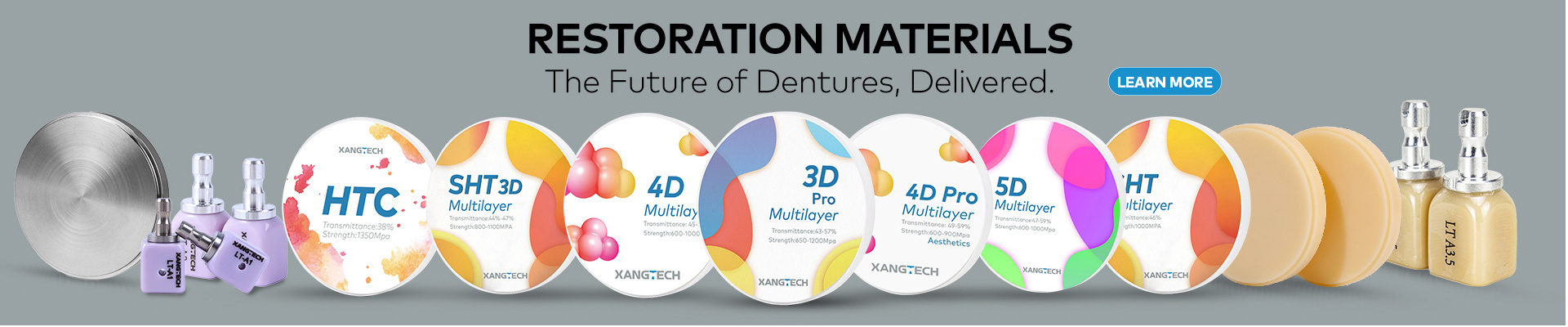
The restoration materials range divides into zirconia blocks, lithium disilicate and glass ceramic, and PMMA discs and blocks, with a small set of category-only lines alongside. Zirconia covers the widest span of crown and bridge work, glass ceramic covers the aesthetic anterior case, and PMMA covers provisionals, try-ins and milled prototypes. A laboratory that knows its case type can usually narrow to one family on this page and then choose within it.
The category-only lines deserve a note of their own. Titanium blocks, PEEK blocks, wax blocks and press ingots appear as category names in the company catalogue. Ask about named products in an inquiry. These lines are listed as categories. A buyer who needs one of those lines can ask about it in an inquiry.
Zirconia blocks in brief
Zirconia blocks come in three families: white, pre-shaded and multilayer. White blanks take their shade from staining after milling, pre-shaded blanks arrive with a shade already in the material, and multilayer blanks carry a shade gradient from the incisal edge to the cervical area inside a single disc. The choice between them is a choice about where the shade work happens, and the zirconia pages explain that trade-off without claiming a laboratory result for any family.
Named lines within the multilayer family include the 4D Pro and 3D Pro products, and the super high translucent 3D multilayer line. Each has its own product page written in descriptive language. Ask for the specification table for the exact line in an inquiry. A buyer comparing them should read the family pages first, then the named product pages, and then ask about the shade and size questions that remain.
Glass ceramic and lithium disilicate
Lithium disilicate and ceramic glass form the second family, aimed at cases where translucency and a natural enamel appearance matter most. The source catalogue lists ceramic glass, lithium disilicate and press ingots as category names, with lithium disilicate as the named product and a Cerec disilicate lithium ceramics block listed as a hot product on one company home page. Cerec appears there only as a third-party system name in the source listing, not as a brand owned by or partnered with this company.
This family is presented on this site as a guide-led category rather than a specification-led one. The lithium disilicate guide explains the category in plain language, compares it with zirconia in general terms, and points shade and thickness questions to an inquiry. Ask for the strength and translucency figures for this family in an inquiry.
PMMA discs and blocks
PMMA covers the provisional and prototype end of the laboratory: monolayer discs, multilayer discs, a super hard block and a pink disc with veins, all listed by name in the source catalogue. The Amann Girrbach name appears on one monolayer disc listing as a third-party system reference, and this site keeps it in that role only. PMMA work is often a try-in or a temporary, so the questions that matter are usually about fit and finish rather than about long-term shade stability.
The PMMA selection guide on this site walks through monolayer versus multilayer discs and the named products in each group, again in descriptive language. A laboratory choosing a PMMA disc for a provisional should read that guide, note the disc size and shade approach it needs, and then confirm availability in an inquiry. Ask for wear and fracture results for these lines in an inquiry.
How materials connect to equipment
A material choice is also an equipment choice, and this index links outward to the equipment that shapes and fires each family. Zirconia blanks go to milling machines and then to sintering furnaces, glass ceramic goes to its own pressing and firing route, and PMMA goes to milling with its own bur and dust considerations. The digital equipment index mirrors this page, so a buyer can move from a blank to the machine that handles it without losing the thread.
That connection is also why the XT-60 milling machine page matters to a materials buyer. Its specification table, the only one on this site, lists the materials it machines, including zirconia, PMMA, PEEK, titanium block and glass ceramic, in the source page's own words. A laboratory can therefore check a material against a machine on the same site, and ask about any combination that is not listed rather than assuming it works.
Choosing a family before a product
The practical advice on this page is to choose a family before a product, and a case type before a family. An anterior crown with a shade gradient points toward multilayer zirconia or glass ceramic, a posterior bridge points toward a zirconia family chosen for its handling, and a provisional points toward PMMA. Those are starting directions, not prescriptions, and the guides on this site develop each one with the caveats that belong to it.
Once a family is chosen, the next step is a product page for a named line, and then an inquiry that names the family, the product, the quantity range and the shade or size questions that remain. The inquiry pages ask for those four confirmations explicitly, because they are the points on which a quotation actually turns. A buyer who arrives at the inquiry with a family already chosen will get a faster answer than one who asks the company to choose from scratch.