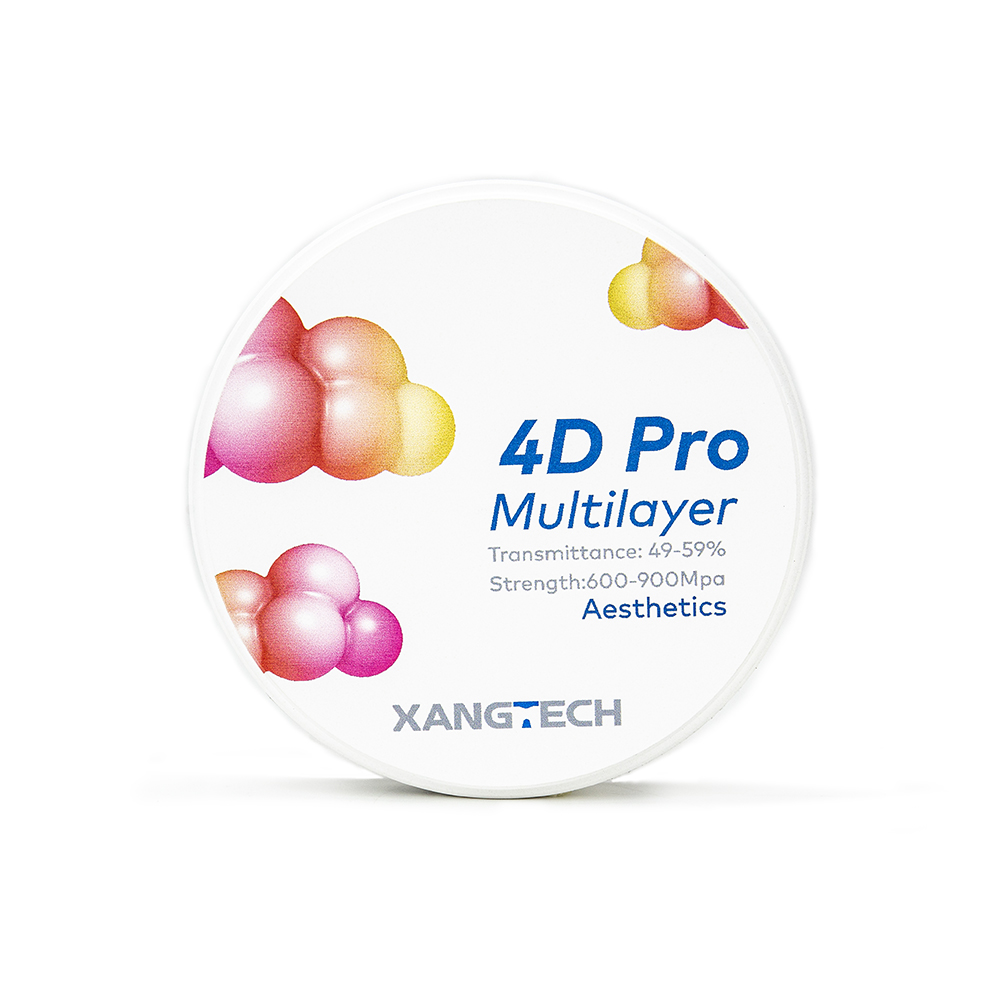
What a multilayer gradient does
A multilayer zirconia disc is built in layers, with translucency increasing toward the incisal edge and chroma increasing toward the cervical area, mirroring the way a natural tooth changes from edge to margin. When a crown is nested inside such a disc, the incisal part of the design sits in the translucent zone and the margin sits in the chromatic zone, so the milled unit already shows a layered appearance before any external staining. That is the whole point of the family, and it is why multilayer blanks are discussed first for anterior work.
The gradient is a property of the blank, not a laboratory result. Before ordering, confirm a measured translucency value and a strength value for the exact blank and case in an inquiry, naming the product and the measurement, and judge the reply on the figures supplied for that blank.
4D Pro, 3D Pro and SHT 3D in one family
The multilayer family on this site contains three named lines from the source catalogue: 4D Pro, listed in full as 4D Pro Multilayer Zirconia Block and 4D Pro Aesthetics Multilayer Zirconia Block; 3D Pro, listed as 3D Pro Multilayer Zirconia Block with several MIC title variants that describe the same family; and the super high translucent 3D multilayer line, listed as SHT 3D. The first two have their own product pages, while SHT 3D is described within this family page, because the sources do not give it a separate product page.
Title variants of this family are treated as one family on this page. MIC listings repeat the same product under several titles, and counting those titles as separate products would inflate the range and confuse a buyer. This site therefore groups variants under the family name, and a buyer who sees a different title on a platform listing can ask in an inquiry whether it matches one of the family lines described here.
Nesting a multilayer case
Nesting matters more for multilayer blanks than for single-shade blanks, because the shade of the finished unit depends on where the design sits inside the disc. A crown nested too high will look too translucent at the margin, and one nested too low will look too chromatic at the edge, so the laboratory's nesting software and the technician's judgement both play a part. This page does not prescribe a nesting position, because the right position depends on the design, the disc and the software in use.
A laboratory new to gradient discs should discuss nesting in its first inquiry, naming the software it uses and the case type it plans. The company can then confirm whether guidance is available for that combination, and the laboratory can test the approach on a single disc before committing to a quantity. That small pilot step is worth more than any general nesting advice a catalogue page could print.
Multilayer versus pre-shaded and white
Compared with pre-shaded blanks, multilayer blanks add a gradient that pre-shaded blanks do not have, at the cost of a nesting step that pre-shaded blanks do not need. Compared with white blanks, multilayer blanks remove most of the staining step, at the cost of a shade choice that is fixed inside the disc rather than chosen by the technician. Neither comparison makes one family better in general; each makes one family better for a particular case, and the comparison page on this site sets the three side by side for that reason.
Ask for laboratory outcome, shade match and fracture figures for the exact family in an inquiry. A buyer who needs that kind of evidence should ask for it in an inquiry, naming the family and the case type, and judge the answer on its specifics rather than on a catalogue superlative.
Milling and sintering a multilayer blank
A multilayer blank follows the same broad route as any zirconia blank: milling on a dental milling machine, sintering in a zirconia sintering furnace, and finishing with burs and glaze paste. The milling step needs a bur suited to zirconia, and the sintering step needs a furnace cycle suited to the blank family. Ask for the cycle and temperature for your blank family in an inquiry. The sintering guide describes the sequence in general terms and points cycle questions to an inquiry.
A sintering curve that belongs to one blank family cannot be safely copied to another, and a curve copied from a general source could damage a case. A laboratory should therefore confirm the cycle for the exact blank it orders, in the same inquiry that confirms quantity and delivery, and keep the company's answer with the order record for that batch.
Ordering multilayer blanks
An order for multilayer blanks should name the family line, the disc size, the shade approach and the quantity range, and then confirm the minimum order quantity, lead time, shipping method and payment terms. Those four confirmations are buyer instructions on this site, not company promises, because they vary by order and destination. A laboratory that names the nesting software it uses will also get a more useful reply, because the company can address the gradient question directly.
Certificates follow the same pattern as the rest of the site: they are available upon request, and a buyer who needs a document for a particular market should name the product and the market in the inquiry. Ask for the certificate number and scope for these lines in an inquiry; a document requested by name is more useful than a certificate name printed without a scope.